
Police Records are the cornerstone for anyone needing a police report request form, a police record lookup, or a criminal background check guide, and the demand for fast online access in California has never been higher. When you wonder how to obtain police records for an insurance claim, employment screening, or a court case, the state police record archive and the police report online portal provide a single point of entry that respects police record confidentiality laws while delivering the essential details you need. Users can expect a clear police record retrieval fee schedule, a transparent police records request timeline, and secure handling under the privacy act, all designed to reduce the hassle of request police records by mail or email. By focusing on the most common queries—such as police report verification service, police report for background screening, and police arrest records search—this introduction sets the stage for a step‑by‑step walk through of the entire request and retrieval workflow.
Police Records also empower individuals to navigate the police record expungement process, understand police report correction procedure, and follow police record sealing guidelines when necessary. Whether you need a police incident report free for a personal matter, a police file request template for legal defense, or tips for a successful police record search, the upcoming sections cover everything from police report for insurance claim to police report for employment verification. Readers will learn how to access the police record database, what information is required for a police report online portal request, and how public access rules differentiate police records public access from restricted files. This foundation equips you to handle police record handling procedures confidently and efficiently.
How to Search Police Records
You can search Police Records through the Sacramento County Sheriff’s Office online portal, which gives you direct access to public report archives. The system lets you look up reports by name, report number, including police blotter, incident number, or date and location. Each search method works best when you have specific details ready. The portal updates regularly so you get current information from the official archive.
Official Search Portal: https://www.sacsheriff.com/pages/records_warrants_faqs.php
Steps to Search
- Visit the Sacramento County Sheriff’s Office official website and click on the Records and Warrants section.
- Choose your search method: name, report number, incident number, or date and location.
- Enter the required details in the search fields, making sure all spelling and numbers match official records.
- Review the list of matching reports and click on the one you need.
- Follow the prompts to request a copy, pay any fees, or save the record for your files.
Search by Person Name
Searching Police Records by person name requires the full legal name of the individual involved. You should add a date of birth or known address to narrow down the results. Common names often show several entries, so extra details help you find the right report. Always double-check spelling to avoid missed records.
Search by Report Number
Searching by report number is the fastest way to find a specific Police Record. The report number appears on your copy of the original report or in any email confirmation you received. Enter the number exactly as shown, including any letters or dashes. This method skips name matching and goes straight to the file you need.
Search by Incident Number
Searching by incident number helps when you have the case identifier from a court document or insurance claim. The incident number links to all reports tied to that event, including supplemental reports. This option is useful for complex cases that have more than one report. It also helps you pull related records from the same investigation.
Search by Date and Location
Searching by date and location works well when you do not know names or report numbers. Enter the date the incident happened and the city or street where it occurred. The system then displays all reports filed for that area and time. You can filter further by report type or agency.
Details Needed to Locate a Record
To locate a Police Record quickly, gather the full name of the person involved, the date of the incident, and the location. Report numbers or incident numbers speed up the search. The name of the reporting agency also helps, especially for reports outside Sacramento County. Having these details ready saves time and reduces the chance of errors.
Sacramento County Police Record Types
Sacramento County Police Records cover several report types, each with a specific purpose. Knowing the type of record you need helps you request the right document. Some reports are open to the public, while others stay restricted. The table below lists the main types and their basic use.
Incident Reports
Incident Reports document any event reported to law enforcement, even if no crime occurred. They show the basic facts of what happened, who was involved, and how officers responded. You can request a copy for personal records, insurance matters, or general reference. These reports form the base document for most police file requests.
Offense Reports
Offense Reports detail criminal acts and list the charges filed. They show the law violated, the suspect information, and the officer’s observations. These reports are often used in court cases and legal defense. You may need one for an expungement petition or a record correction.
Accident Reports
Accident Reports cover traffic crashes and show the vehicles, drivers, and damage. They also list road conditions, witness statements, and the officer’s diagram. Insurance companies usually ask for these reports when processing claims. You can also use them for DMV matters or personal injury cases.
Investigative Reports
Investigative Reports come from active criminal probes and are often kept private. They include suspect interviews, evidence notes, and case strategy. Most of these reports stay restricted until the case closes. Release depends on the California Public Records Act and court orders.
Supplemental Reports
Supplemental Reports add new facts to an existing case after the first report. Officers file them when they find more evidence, identify new witnesses, or correct errors. These updates are part of the official record and may be released with the original report. Always check for supplemental reports when you verify a case file.
Dispatch and Call Records
Dispatch and Call Records show 911 calls, radio traffic, and response times. They confirm that an incident happened and list the units that arrived. Insurance adjusters and attorneys often ask for these records to confirm timelines. They are part of the public archive unless tied to a restricted case.
Information Contained in Police Records
Police Records hold key facts about an incident, the people involved, and the response by officers. Each section of a report serves a specific role and helps verify the event. The table below shows what you can expect to find in a standard report.
Incident Description
The incident description gives a short summary of what the reporting officer found at the scene. It lists the type of event, the actions taken, and any injuries or damage. This section sets the basis for the rest of the report. You can use it as a quick reference when you need to confirm basic facts.
Date and Time
The date and time field shows exactly when the incident happened and when the report was filed. This detail is critical for insurance claims and court filings. It also helps match the report to dispatch logs. Always check that the date matches the event you are researching.
Location
The location field lists the address, cross streets, or area where the event took place. For traffic accidents, it may show the road or highway number. This field helps you confirm you have the right report. It also assists in matching the case to other local records.
Involved Parties
The involved parties section lists victims, witnesses, and suspects tied to the case. It shows names, contact details, and roles in the incident. Personal data may be redacted in public copies. You need this section for background checks, court cases, or insurance disputes.
Officer Information
The officer information section lists the names and badge numbers of the responding deputies or police officers. It shows who arrived on scene and who wrote the report. This data helps you verify the report’s source. It is also useful when you need to follow up with the agency.
Property or Vehicle Details
Property or vehicle details show items taken, damaged, or tied to the case. For vehicle accidents, the report lists make, model, year, and license plate numbers. For theft cases, it shows serial numbers and item descriptions. Insurance adjusters rely on this data for claims.
Report and Case Numbers
Report and case numbers are unique codes assigned to each incident. They link the report to supplemental reports, court files, and other related records. Always record these numbers when you request a copy. They make future searches much faster and more accurate.
Police Records by Law Enforcement Agency
Police Records are held by the agency that responded to the call or filed the report. Sacramento County has several agencies, each with its own archive. Knowing which agency to contact saves time and avoids denied requests. The list below shows the main agencies you may need.
- Sacramento County Sheriff’s Office
- Sacramento Police Department
- Citrus Heights Police Department
- Elk Grove Police Department
- Folsom Police Department
- Galt Police Department
- Rancho Cordova Police Department
Sacramento County Sheriff’s Office Records
The Sacramento County Sheriff’s Office keeps records for unincorporated areas and contract cities. You can request reports from this agency through the official portal or by mail. The office handles incident, offense, and accident reports in the county. Most records are public unless restricted by law.
Municipal Police Department Records
Municipal police departments keep records for events within city limits. Each city in Sacramento County has its own records unit. You need to contact the specific city agency to get those reports. Online portals or in-person visits work for most requests.
Records by Jurisdiction
Jurisdiction decides which agency holds the report. The city or unincorporated area where the incident happened determines the right office. Cross-jurisdictional cases may need requests from more than one agency. Always confirm the location before you file your request.
Determining the Correct Agency
To determine the correct agency, check the location of the incident. If it happened in a city, contact that city’s police department. If it happened in an unincorporated area, contact the county sheriff. You can also call the non-emergency line for help identifying the right office.
Records Held Outside County Jurisdiction
Records held outside county jurisdiction need to be requested from the agency that covers that area. State highways may involve the California Highway Patrol. Federal properties fall under federal agencies. You can ask the Sacramento County Sheriff’s Office for help finding the right contact if you are unsure.
Requesting Police Records
Requesting Police Records in Sacramento County can be done online, by mail, or in person. Each method has its own process, fees, and timeline. The table below compares the three options to help you choose the best one for your needs.
Online Requests
Online requests go through the Sacramento County Sheriff’s Office portal. You fill out the form, pay the fee, and download the report when ready. This method is fast and lets you track your request status. It is the most common way to get Police Records today.
Mail Requests
Mail requests require a written letter or police file request template sent to the records office. You must include your contact details, the report number, and a self-addressed stamped envelope. Add a check or money order for the copy fee. Mail requests take longer to process than online ones.
In-Person Requests
In-person requests let you speak with records staff directly. You fill out a request form at the office and pay the fee on the spot. Staff can help you find the right report if you have basic details. This method works well for urgent requests or complex searches.
Information Required for a Request
You need to provide the full name on the report, the date of the incident, and the location. The report or case number speeds up the process. You also need to show valid ID for restricted records. Include your contact details so the office can reach you with updates.
Copy Fees
Copy fees cover the cost of printing and processing the report. Standard reports cost a set fee per page or per report. Special records or large files may cost more. The records office will tell you the exact amount before you pay. Fees apply to both public and restricted records.
Processing Times
Processing times depend on the request method, along with arrest lookup, the report type. Online requests often finish within a few business days. Mail requests may take several weeks. In-person requests can sometimes be handled the same day. Restricted reports take longer due to review and redaction.
Public Access to Police Records
Public access to Police Records in California is governed by the California Public Records Act. Most basic reports are open to the public, but some stay restricted. The list below shows the types of records you can usually access.
- Incident reports for non-violent events
- Traffic accident reports
- Arrest logs for adult suspects
- Calls for service summaries
- Crime statistics and reports
Publicly Accessible Records
Publicly accessible records include basic incident reports, traffic accident reports, and arrest logs. You can request these without giving a reason. The agency must release them unless a specific law blocks access. Always check the agency website for the most current list of public records.
Restricted Records
Restricted records include active investigations, juvenile cases, and certain personal data. Law enforcement can withhold these under state law. You need a court order or specific legal reason to access them. The agency will tell you why a record is restricted when you ask.
Confidential Information
Confidential information includes Social Security numbers, home addresses, and phone numbers. This data is removed before public release. Officers also redact medical details and personal identifiers. The goal is to protect privacy while still showing the facts of the case.
Redacted Records
Redacted records are public reports with sensitive data blacked out. You still get the main facts of the case. Redaction follows strict rules under California law. You can ask for a description of what was removed and why.
Records Exempt From Disclosure
Records exempt from disclosure include personnel files, informant identities, and certain investigative techniques. These stay private even after a case closes. Exemptions protect ongoing law enforcement work and personal safety. The agency will cite the specific exemption when denying a request.
Juvenile Information Restrictions
Juvenile information restrictions protect minors involved in police matters. Names, schools, and details about juveniles are kept private. Only parents, lawyers, and approved agencies can access this data. Court orders may also allow release in certain cases.
Police Record Updates and Corrections
Police Record updates and corrections happen when new facts come to light or errors are found. You can request a change if you have proof that a report is wrong. The agency will review your request and decide what to update. Common updates include supplemental reports, corrected reports, and administrative changes.
Supplemental Reports
Supplemental Reports are filed by officers to add new information to a case. They often follow interviews, lab results, or witness statements. These reports are part of the official record. They can be requested alongside the original report for a full picture.
Updated Case Information
Updated case information shows changes to the status of a case, such as arrests made or charges added. This data appears in the agency’s system over time. You can request an update if you need the current status of a case you already pulled. This is common in long investigations.
Corrected Reports
Corrected Reports replace or fix parts of an original report. Officers file them when they spot a mistake or get new facts. You may receive both the original and corrected versions. The agency will note which report is the most current.
Administrative Changes
Administrative changes include typos, name corrections, or date fixes. These small updates are filed through the records office. They do not change the facts of the case but improve the accuracy of the file. You can request a correction by contacting the records unit.
Requesting a Record Correction
To request a record correction, submit a written request to the records office with proof of the error. Include your contact details, the report number, and a clear explanation. The agency will review your request and notify you of the decision. You can appeal if your request is denied.
Police Records Verification
Verifying Police Records confirms that the report you have is real and accurate. This step matters for court cases, insurance claims, and employment screening. You can check the report number, names, dates, and agency details. The list below shows key steps for proper verification.
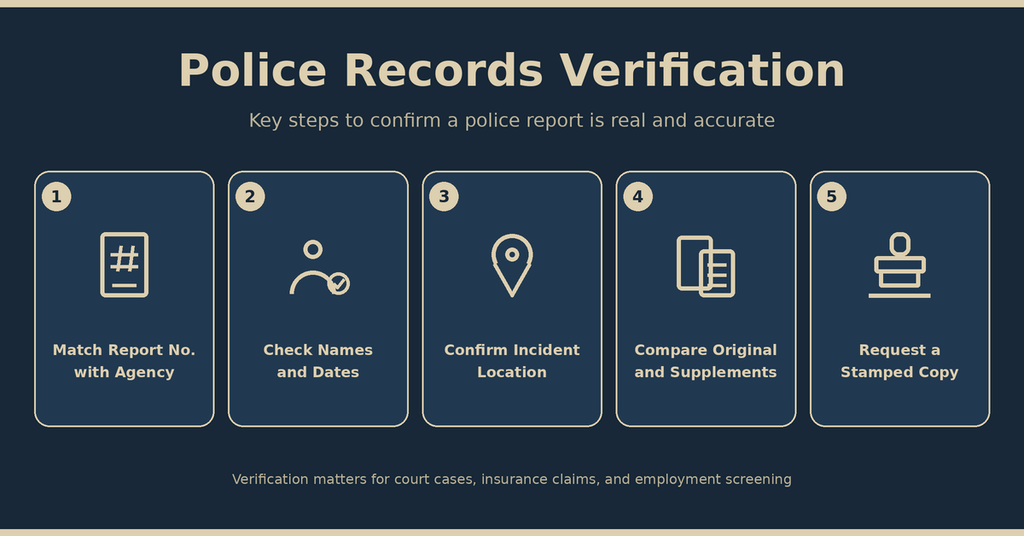
Confirming Report Numbers
Confirming report numbers means checking that the number on your copy matches the agency’s database. You can call the records office to verify. Some agencies also offer online verification tools. This step stops the use of fake or altered reports.
Matching Names and Dates
Matching names and dates helps you confirm the report covers the right person and event. Check spelling, date of birth, and incident date. Small errors can lead to the wrong record. Always cross-check with other documents you have.
Checking the Reporting Agency
Checking the reporting agency makes sure the report came from the right office. Each agency has its own report format and numbering system. The agency name and logo should match official sources. You can verify by contacting the agency directly.
Confirming Incident Locations
Confirming incident locations shows the report covers the right place. The address or cross streets should match what you know. This step is critical for insurance and court matters. It also stops mix-ups between similar cases.
Comparing Original and Supplemental Records
Comparing original and supplemental records shows the full timeline of a case. Supplemental reports often add new facts or correct errors. Always request both when verifying a case. This gives you a clearer picture of the investigation.
Police Records Search Problems
Common Police Records search problems include missing records, wrong names, and restricted files. Each problem has a clear cause and a simple fix. The table below shows frequent issues and how to handle them.
Record Not Found
A record not found error usually means wrong details or a recent filing. Double-check the spelling, date, and report number. If everything looks right, wait a few days and try again. Records often take time to enter the system after an incident.
Incorrect Name or Spelling
An incorrect name or spelling can block your search. Try alternate spellings or known aliases. You can also add a date of birth to narrow the results. The records office can help if you have other identifying details.
Incorrect Report Number
An incorrect report number will lead to no results. Check the number on your original copy for typos or missing digits. Contact the agency if you cannot find the right number. Staff can look it up using your name and date of the incident.
Wrong Law Enforcement Agency
A wrong law enforcement agency request will be denied. Make sure you contact the agency that covers the location of the incident. If you are unsure, call the county sheriff’s office for help. They can direct you to the right records unit.
Recent Record Not Available
A recent record may not be available right away. Officers need time to file and approve reports. Wait a few business days and try again. Some records, like accident reports, often take longer to process.
Restricted or Redacted Record
A restricted or redacted record cannot be fully released to the public. You will get a copy with sensitive data blacked out. If you need the full record, you may need a court order. The agency will explain the reason for the restriction.
Delayed Record Availability
Delayed record availability happens when an agency has a backlog. Mail and in-person requests often face longer delays. Online requests usually process faster. Contact the records office if your request takes longer than the listed timeline.
Contact Information
You can reach the Sacramento County Sheriff’s Office Records Unit for questions about Police Records, fees, or processing times. The office is open during regular business hours and handles in-person requests. You can also use the official website for online requests and updates.
Frequently Asked Questions
Find quick answers about accessing police records, fees, timelines, and online tools for Sacramento County.
How can I request police records in Sacramento?
You can request police records by visiting the Sacramento County Sheriff’s Office at 4510 Orange Grove Avenue, Sacramento, CA 95841, or by calling (916) 874-5383 during office hours. Fill out the police report request form available on the official website. Submit the form in person, by mail, or via the online portal. Include the name, incident number, or date of the report you need. Identification may be required, and a small retrieval fee often applies. The office processes requests Monday through Friday, excluding holidays.
Where is the police report online portal?
The police report online portal is located at https://www.sacsheriff.com/pages/records_warrants_faqs.php. This site lets you search the state police record archive using a name, report number, incident number, or date. Results update regularly, giving you current information from the official archive. After locating the desired record, you can request a copy through the portal or follow the instructions for mail or in‑person requests. The portal is accessible 24/7 without needing a special account.
What fee applies to police record retrieval?
Most police record retrievals require a modest fee set by the Sacramento County Sheriff’s Office. The fee covers copying and handling costs and varies by document type. Standard reports like incident summaries often cost a few dollars per page, while larger files may incur higher charges. Payment can be made by cash, check, or credit card when you pick up the record or include it with a mailed request. The exact amount appears on the request form before you finalize the submission.
Can I get a police incident report free for insurance?
Yes, a police incident report can be obtained at no cost when it is needed for an insurance claim. Submit a request stating the purpose is for insurance, and include the claim number if available. The sheriff’s office may waive the retrieval fee for this specific use. Provide the incident date, location, and any identifying numbers to speed up the search. Once verified, you can receive the report by mail or pick it up in person during regular office hours.
How long does a police records request take?
Typical processing time for a police records request ranges from three to five business days after the office receives a complete form and payment. Requests submitted online or in person often finish faster than mailed requests, which add postal transit time. Urgent requests may be expedited for a higher fee, but standard timelines apply to most cases. You can check the status by calling the office or using the online portal’s tracking feature if available.